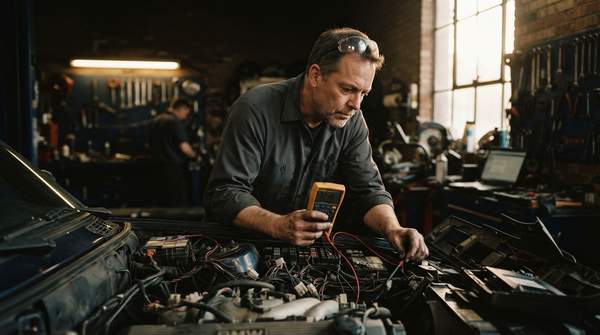
A 40-year veteran mechanic in rural Ohio recently spent $75,000 on specialized EV diagnostic equipment, a cost he fears many peers cannot afford. A capital expenditure crisis for independent repair shops is evident; only 10% of US shops are currently equipped to service high-voltage EV batteries, according to the Automotive Aftermarket Suppliers Association. The rise of electric vehicles promises simpler, lower-maintenance vehicles, but it demands a far more complex and expensive skill set and infrastructure from the auto repair industry. Many independent shops will struggle to adapt due to significant investment in training and equipment, coupled with a fundamental shift in vehicle mechanics. The result will be consolidation, a shortage of skilled EV technicians, and potentially higher repair costs for consumers as the market matures.
The New Mechanics: Why EVs Break Differently
Electric vehicle powertrains contain 90% fewer moving parts than internal combustion engines, drastically reducing traditional maintenance needs like oil changes and spark plug replacements, according to Deloitte Automotive Trends. A deeper complexity for repair professionals is present, however, despite this mechanical simplicity. Mechanics now require an average of 80-120 hours of specialized high-voltage safety and EV system training to service these vehicles safely and effectively, reports the National Institute for Automotive Service Excellence. Battery management systems, regenerative braking, and complex software diagnostics are covered by this intensive training, representing a significant departure from traditional mechanical repairs.
Even hybrid vehicle repair, which still involves some internal combustion engine components, introduces complex electrical systems demanding specialized training beyond traditional mechanics, according to the Hybrid Repair Institute. Traditional mechanical expertise becomes devalued, creating a skills gap that few existing technicians are prepared to bridge.
The Numbers Game: Quantifying the EV Repair Gap
- 30% — The global EV market share is expected to reach this figure by 2030, a substantial increase from 15% in 2023, according to the International Energy Agency.
- $20,000 to over $100,000 — The average cost for EV diagnostic equipment can range this widely, representing a significant barrier for small businesses, reports Modern Mechanic Magazine.
- 25% — The number of certified EV technicians in the US is projected to be this percentage below demand by 2030, according to Bureau of Labor Statistics projections.
- 25% higher — The average repair bill for an EV is currently this much higher than for an internal combustion engine vehicle, partly due to specialized labor and parts, states CCC Intelligent Solutions.
A rapidly expanding EV market will soon face a severe shortage of equipped shops and trained technicians, as indicated by these figures. This gap will drive up repair costs, making EV ownership more expensive than anticipated for many consumers.
From Oil Changes to Battery Swaps: A Business Model Upheaval
Local repair shops have historically relied on high-volume, routine maintenance tasks like oil changes and spark plug replacements, which are largely absent in electric vehicles, notes the Independent Garage Owners Association. The evaporation of this foundational revenue stream is forcing shops to rethink their entire business model.
The perceived 'simplicity' of electric vehicles is a deceptive mirage for consumers. When an EV breaks, the repair bill will be astronomical, and only a handful of highly specialized, often dealership-affiliated, technicians will be equipped to fix it. A single EV battery pack replacement can cost upwards of $15,000 to $20,000, often exceeding the value of an older EV, according to Consumer Reports.
Automakers push aggressively for EV adoption, often highlighting environmental benefits and reduced running costs. Yet, they centralize EV repair knowledge and proprietary diagnostic tools within their dealership networks. Tesla's repair model, for instance, often involves proprietary diagnostics and parts, limiting independent shop access, reports TechCrunch. Manufacturers aim to recapture a larger share of aftermarket service revenue.
Insurance companies are also developing new protocols for assessing EV damage, particularly battery integrity after collisions, according to Allstate Insurance. Another layer of complexity and cost is added to post-accident repairs, further differentiating EV service from traditional vehicle repair.
Who Thrives, Who Struggles: The Industry's Shifting Fortunes
Dealerships currently handle over 70% of EV service, a significant increase compared to their 50% share for internal combustion engine vehicles, according to a J.D. Power EV Service Study. Existing infrastructure, access to proprietary diagnostic tools, and mandated manufacturer training for technicians are the source of this dominance.
Traditional auto parts suppliers anticipate a 30-40% decline in demand for certain ICE-specific components over the next decade, reports the Auto Parts Manufacturers Council. Diversification or contraction for their business models is forced.
Mobile EV repair services are also emerging, offering convenience directly to consumers but further fragmenting the traditional shop model, notes EV Repair Solutions Inc. Competitive pressure is added to brick-and-mortar operations by this new channel.
The average age of an independent auto mechanic is 48, with many nearing retirement and less inclined to invest in extensive EV retraining, according to the Automotive Service Association. The skills gap is exacerbated and potential shop closures are accelerated by this demographic reality.
Navigating the Future: Expert Predictions and Solutions
Some states are offering grants up to $15,000 for independent shops to invest in EV training and equipment, such as programs from the California Energy Commission. The financial blow for smaller businesses attempting to adapt is the target of these initiatives.
Vocational schools are also responding, with some seeing a 50% increase in enrollment for EV-specific technician programs, according to the Universal Technical Institute. A new generation of mechanics is preparing for the electric future, as indicated by this growth.
However, 'The biggest challenge isn't just the technology, it's convincing seasoned mechanics to embrace a completely new way of thinking about cars,' states an automotive industry consultant from Auto Industry Insights. A significant hurdle to widespread adaptation, even with financial incentives, remains due to this cultural resistance within the existing workforce.
By Q3 2026, many smaller, independent auto repair shops, particularly those with owners nearing retirement, will likely face the critical decision of either investing upwards of $75,000 in EV retooling or closing their doors, fundamentally altering local service availability for consumers.