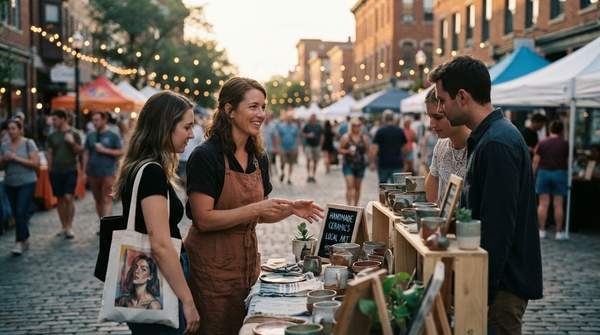
If you run a small business in a downtown or main street district, the community events around you are not just civic decoration—they are marketing channels with different audiences, goals, and demands on your time. Art walks pair your storefront with local artists to attract a new, culturally minded crowd. Seasonal markets turn your space or a shared venue into a platform for local commerce and direct customer connection. Sidewalk sales put your merchandise physically in the path of passersby to drive immediate foot traffic. This guide compares the three formats and closes with tactics that work at any of them.
Understanding Community Events for Downtown Business Growth
Community events work for small businesses because they concentrate people in one place at one time, and they give business owners something no advertisement can: a face-to-face moment. As the Wisconsin Economic Development Corporation's guidance for small businesses engaging with downtown events explains, meeting potential customers in this type of setting gives owners a chance to share their passion and knowledge, and the story behind their products. That direct connection often leads to increased sales and fosters customer loyalty, because attendees make a memorable connection with the businesses and their offerings.
The strategic value extends beyond a single day. Collaborations among participating businesses expand each shop's customer base while strengthening the small business network itself, so that by supporting and promoting each other, businesses collectively contribute to the vibrancy of the local entrepreneurial ecosystem. The question is not whether to engage with community events, but which format matches your goals and resources.
Art Walks: Showcasing Creativity and Attracting New Demographics
An art walk is a coordinated event that pairs local artists with downtown businesses in an interactive experience. The scale can be substantial: the Art Walk in De Pere, Wisconsin, matches more than 25 businesses with artists including painters, jewelers, sculptors, and photographers. For a business owner, the appeal is twofold—you support local creative talent, and you attract an audience that may not otherwise walk through your door.
Event-planning guidance suggests partnering with local artists to showcase their work at your location, turning your space into what one community-engagement resource calls a vibrant community hub for art lovers. The practical opportunity is cross-promotion: the artist brings their following, you bring your regulars, and each gains exposure to the other's audience. Art showcases can also be themed, which makes them a flexible format for attracting new customers around a season, a holiday, or a local anniversary. Your role as a host business is relatively light—provide the venue, promote the pairing, and be present to talk with visitors.
Seasonal Markets: Fostering Local Commerce and Community Connection
Seasonal markets—summer markets, fall harvest festivals, winter holiday markets—bring together local vendors, farmers, and artisans to sell their products. They can draw attention to participating businesses while offering enjoyment for all ages, and they are well suited to collaborative promotions with other local businesses.
The distinctive business opportunity is direct connection. Setting up a vendor booth lets you sell your products in person and share the story behind them, which is where the loyalty-building happens. Square's small business guidance suggests that hosting a community market, by turning your space into a platform for other local businesses, can attract crowds and build goodwill. This approach allows businesses to support other local brands, draw new customers, and establish themselves as community connectors. Hi-Lo Liquor Market, for example, has centered its brand around this strategy. The trade-off is effort: a booth means staffing, inventory, and setup, but it also means a full day of face-to-face selling to people who came specifically to browse local goods.
Sidewalk Sales: Driving Foot Traffic and Boosting Immediate Sales
The sidewalk sale is the simplest of the three formats: businesses set up tables and displays outside their stores and offer discounts and promotions to entice attendees inside. Downtown Rhinelander, Wisconsin, hosts an annual Redikulus Dae event where local shops bring their items outside and set up entertaining sidewalk sale displays—a model that works both as a standalone promotion and as a way to ride the foot traffic of a larger downtown event.
The primary goal here is immediate: attract passersby and convert them into customers with a promotion. The format suits businesses with inventory to move, seasonal stock to clear, or a location that benefits from visible street-level activity. It requires the least coordination of the three—an existing event nearby is an opportunity, not a prerequisite, since businesses can take advantage of increased foot traffic during downtown events by hosting their own pop-up events or sidewalk sales. What it offers less of is the relationship-building depth of a market booth or the demographic reach of an art walk; the discount is the draw, and the sale is the point.
Community Event Comparison for Downtown Businesses
The table below compares the three formats across the dimensions that matter most when choosing where to invest your time: why the event exists, what your business stands to gain, and a concrete way to participate.
| Event Type | Primary Goal | Key Business Opportunity | Example Tactic |
|---|---|---|---|
| Art Walk | Showcase local art, build community, and attract new customers | Attracts a different demographic and offers cross-promotional opportunities with artists and their followings | Collaborate with local artists or host in-store events, turning your space into a community hub |
| Seasonal Market | Support local businesses, promote local products, and build community | Direct face-to-face connection with customers, leading to increased sales and customer loyalty | Set up a vendor booth to sell products and share the story behind them |
| Sidewalk Sale | Attract passersby and offer discounts and promotions | Increased foot traffic and immediate sales from people already walking by | Set up tables and displays outside your store with discounts to entice attendees inside |
Read side by side, the strategic profiles clarify the trade-offs. The art walk is a reach play—new demographics through partnership. The seasonal market is a relationship play—depth of connection at the cost of booth effort. The sidewalk sale is a conversion play—immediacy at the cost of long-term engagement. A business with slow-moving seasonal inventory has a different first choice than one trying to introduce itself to a new neighborhood.
Maximizing Your Business's Impact at Any Event
Whichever format you choose, the same engagement principles apply. Event-planning advice for small businesses recommends keeping the event simple, well-promoted, and customer-friendly, because personal interaction is often the biggest advantage a small business has over larger competitors.
Concretely, that means three things. First, create event-specific promotions so that any sale or offer can be traced back to the event itself. Second, use adjacent events: when a downtown event brings a crowd, host your own pop-up or in-store happening to capture the spillover foot traffic. Third, lean on collaboration—partner with artists, other vendors, or neighboring shops, since supporting and promoting each other expands everyone's customer base and strengthens the small business network that makes future events possible.
Choosing the Right Event for Your Business
Businesses should select community events that directly align with their specific objectives, whether that is increasing brand visibility, driving immediate sales, or fostering long-term customer loyalty. An art walk suits the visibility goal, a seasonal market suits the loyalty goal, and a sidewalk sale suits the immediate-sales goal. The measurable indicator to watch afterward is increased customer engagement and sales directly attributable to event participation, measured by tracking event-specific promotions or new customer acquisition. If the event-specific promo code goes unused and no new faces appear at your counter, the format was the wrong fit—try the next one on the table.
Sources
- Top 10 ways for small businesses to engage with downtown events — WEDC
- What are the best event types for local businesses? - MyEventsNow — Myeventnow
- Local Events, Big Impact: 15 Ideas for Engaging with Your Community — Clarityvoice
- 10 Creative Event Ideas To Grow Revenue and Build Community — The Bottom Line by Square