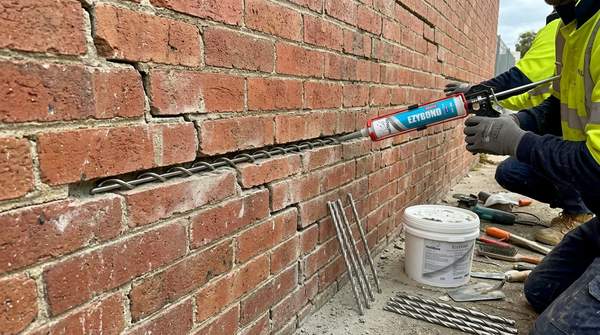
A crack that climbs diagonally through brickwork can resemble a staircase drawn across the wall. It follows one horizontal mortar joint, turns through a vertical joint and continues through the next course, sometimes extending for several metres before it ends.
The pattern offers useful evidence about how the building has moved. Once the cause and condition of the masonry have been assessed, HeliMate Australia’s stainless steel helical bars and bonding products provide materials for a specified crack-stitching repair that can retain much of the original wall.
Why Cracks Follow the Brick Courses
Brick walls consist of overlapping units connected by horizontal bed joints and shorter vertical joints. Movement introduces stress into that network, and a fracture may travel along successive mortar joints rather than forming a straight line through the bricks.
The resulting stepped pattern can appear near a building corner, along an uninterrupted façade or around an opening. The direction, width and position of the crack help a building professional identify where movement may be occurring.
The surrounding bricks tell part of the story too. Loose units, fractured brick faces or displacement across a joint can indicate a different condition from a narrow, stable crack in otherwise sound masonry.
Ground Moisture Can Change the Way a House Moves
Many Australian homes stand on soils that respond to changes in moisture. Reactive clays can swell when wet and shrink during dry conditions, changing how different parts of a footing are supported.
A house rarely experiences perfectly uniform movement across its entire footprint. If one section of the supporting ground changes more than another, stresses can develop in the brickwork above, sometimes appearing as diagonal stepped cracking.
Archicentre Australia’s guidance on masonry cracking identifies seasonal moisture changes, soil conditions and vegetation among the influences on footing movement. It also notes that crack patterns and their behaviour over time can help determine whether further investigation or remedial work is appropriate.
Drainage adds another variable. A leaking downpipe, altered landscaping or prolonged wetting close to one part of a building can change local ground conditions, while established trees can influence moisture in surrounding soil.
What to Record When a Stair-Step Crack Appears
A useful assessment begins with observations that can be checked again later. The goal is to understand the fracture in the context of the whole building, especially when its history is unknown.
| Observation | Information it provides |
|---|---|
| Crack direction and location | Shows which wall sections and openings may be affected |
| Width at several points | Records whether the gap varies along the fracture |
| Displacement across the joint | Indicates whether the two sides have moved out of alignment |
| Condition of bricks and mortar | Identifies deteriorated areas that may need local masonry repair |
| Changes over time | Helps establish whether movement is continuing |
| Nearby drainage or ground changes | Provides context for a footing or moisture investigation |
Photographs taken from consistent positions can show the crack’s location and any visible development. A building professional may also take measurements or recommend monitoring when there is uncertainty about whether movement has stabilised.
The position of a fracture should be considered with other observations. Doors that begin sticking, separation at wall junctions or changes in the shape of an opening can help reveal how widely movement has affected the building.
Establish the Repair Before Selecting the Reinforcement
Stair-step cracking can result from different structural and environmental conditions, so the repair follows an assessment of its cause. A stable fracture in sound masonry may call for a more limited intervention than a wall showing progressive distortion or damaged support.
Where structural reinforcement is specified, the designer identifies the joints to be stitched, the size and length of each bar, and the required anchorage into sound material. Any associated drainage, footing or masonry repairs can be coordinated within the same programme.
Significant displacement, rapidly widening cracks or loose masonry warrant prompt professional assessment. The priority in such cases is establishing the wall’s stability and the appropriate remedial measures before cutting joints or placing reinforcement.
How HeliMate Bars Stitch Across a Stepped Crack
Crack stitching uses horizontal slots prepared in selected mortar joints that cross the fracture. Stainless steel helical bars are embedded within those slots and extend into suitable masonry beyond the crack, creating a reinforced connection through the affected courses.
HeliMate Australia supplies 6mm and 8mm straight bars in 1,000mm lengths, made from cold-pressed 316L stainless steel. Both diameters are also represented in its helical coil range, providing supply options for different specified reinforcement lengths.
The twisted steel profile interacts with the surrounding bedding material. The completed assembly transfers forces through the reinforced joint according to the design, while the bars remain concealed when the mortar finish is restored.
This is particularly attractive for exposed brick homes because the reinforcement follows the existing masonry layout. Retaining suitable original bricks can reduce the visual disruption associated with removing and rebuilding larger sections of an otherwise sound wall.
A Repair Sequence That Respects the Existing Brickwork
HeliMate’s installation guide sets out the general process for bedding helical bars in horizontal mortar joints. The approved repair design establishes the actual arrangement and the compatible products for the specific structure.
- Identify the reinforcement courses. Use the repair drawing to mark each horizontal joint and the bar length required across the stepped fracture.
- Prepare the specified slots. Remove mortar carefully while protecting sound brick edges and using suitable controls for hazardous masonry dust.
- Clean and inspect the joints. Remove loose mortar and cutting residue, then check that the receiving surfaces are suitable for the selected bedding material.
- Install the bars. Place an initial layer of compatible bonding product, position the specified helical reinforcement and complete its encapsulation.
- Repoint the visible surface. Follow the bonding product’s curing requirements, then restore the exposed joint with mortar suited to the surrounding brickwork.
HeliMate offers EzyBond two-part anchoring epoxy and EzyGrout cementitious grout for compatible crack-stitching applications. The selected product determines the dispensing equipment, preparation conditions and curing sequence.
Finish the Wall Without Losing Its Character
A stepped crack often crosses a highly visible area of brickwork. Once concealed reinforcement is installed, careful repointing can restore the horizontal and vertical joint pattern and allow the repaired courses to sit naturally beside the original masonry.
Mortar colour depends on its sand and binder, while the joint profile affects how light and shadow fall across the façade. On older walls, a compatible mortar composition also helps protect the original bricks and their response to moisture.
Some fractured bricks may require local replacement or other repairs as part of the approved work. The result can combine reinforcement within selected joints with a finished surface that retains the building’s established appearance.
Select the Materials Around the Repair Layout
A crack-stitching schedule lists the number, diameter and length of the bars at each location. HeliMate’s 6mm and 8mm straight bars, coils and compatible bedding products give contractors a focused selection from which to assemble that order.
For a project involving several fractures, the contractor can group reinforcement by diameter and identify the required bonding material and installation accessories. HeliMate also supplies a double-barrel epoxy gun and mortar raking disc, providing related equipment for appropriate repair methods.
The product selection becomes more straightforward once the wall assessment has established the repair. A well-defined schedule connects each stainless steel bar with the cracked masonry it is intended to reinforce.
Restore Cracked Brickwork With HeliMate Australia
Stair-step cracking reveals where brickwork has responded to movement, and a properly specified repair can reinforce suitable masonry while preserving its familiar appearance. Choose HeliMate Australia’s 6mm or 8mm helical bars and compatible bedding products for the approved crack-stitching layout, and enquire about the quantities needed to complete the repair.