There is no single best way to buy local food—there is only the best fit for your schedule, budget, and cooking habits. Farmers' markets offer face-to-face connection and pay-as-you-go flexibility, but demand a trip during market hours. Community Supported Agriculture (CSA) programs lock in a season of produce for one upfront payment, trading flexibility for predictability. Food hubs and local delivery services aggregate products from multiple farms and bring them to your door, adding convenience at the cost of a mediated relationship with the growers themselves. This guide compares all three so you can match the model to your household's priorities for convenience, cost, variety, and community connection.
Understanding Local Food Sourcing: Your Options
Local food reaches your kitchen through two broad routes. Farmers can sell directly to you—at farmers' markets, through CSA subscriptions, or via pick-your-own programs—or they can work through an intermediary such as a cooperative, food hub, retailer, restaurant, or school to distribute their produce locally. That distinction, described by the Sustainable Agriculture Research and Education (SARE) program, matters because it shapes everything downstream: how much you pay, when you pay it, and how well you know the person who grew your food.
Many farmers use several of these channels at once as a risk management strategy, and some channels—like cooperatives and food hubs—aggregate products from multiple farms to provide the volume and consistency needed to reach larger markets. For you as a shopper, that means the three most common consumer-facing models each carry a distinct cost structure and commitment level. A business-oriented comparison of sourcing channels, published by CloudKitchens, characterizes them this way: farmers' markets involve buying direct from individual producers with variable pricing and no contracts; food hubs aggregate local supply through a single distributor with more predictable pricing; and co-ops and CSAs involve shared purchasing through a producer collective at lower per-unit cost but with less flexibility.
Farmers' Markets: Direct Connection and Freshness
The farmers' market is the most familiar entry point into local food, and its appeal is easy to trace. A survey of New Jersey farmers' market patrons, cited in USDA Economic Research Service research, found that purchase decisions were driven most by quality and freshness—63 percent and 59 percent of respondents respectively—well ahead of convenience (20 percent) and price (16 percent). In other words, people come for the food itself, not the bargain.
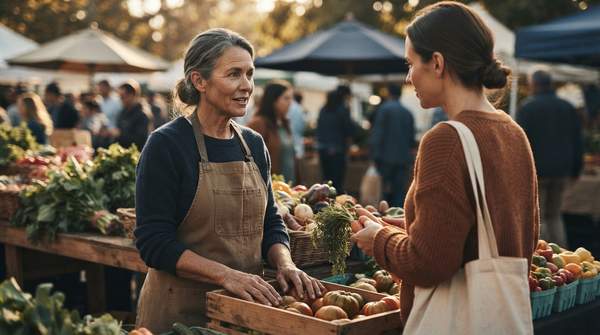
For your household, the market model means paying per item at the point of sale, with no contract and no upfront commitment. You can buy a single basket of tomatoes or a week's worth of vegetables, and you can walk away having spent only what you chose to. The trade-off is scheduling: you must visit a specific location during market hours, and what's on offer is seasonal, tied directly to local growing seasons and to whichever farmers showed up that day. What you gain is the most direct connection of any channel—farmers sell their products straight to the consumer, and SARE notes that many producers share their farm story at these outlets, satisfying shoppers' desire to know the origin of what they eat.
Community Supported Agriculture (CSA): Commitment for a Share of the Harvest
A CSA inverts the market model. Instead of paying per item as you go, community members pay a produce subscription fee before the season starts, receiving regular shares of the harvest in return. That early payment is not incidental—it provides the farmer with capital at the beginning of the season, when it's most needed, and it shares the risk of farming with the consumer. A bumper crop means overflowing boxes; a poor one means leaner ones.
For budgeting, this makes a CSA the most predictable of the three options: one payment, one season, no weekly decisions. The CloudKitchens comparison frames co-ops and CSAs as lower per-unit cost but less flexible—best suited to predictable, recurring needs. The commitment is real, though. You receive a pre-selected box on a regular pickup or delivery schedule, which means less choice about what lands on your counter and a household obligation to actually cook through whatever arrives. If your household dislikes surprises, eats out often, or can't reliably collect a weekly share, that inflexibility is the model's main cost. If you enjoy cooking seasonally and want your food dollars to support one farm's whole season, it's the deepest form of commitment available.
Food Hubs & Local Delivery Services: Convenience Meets Aggregated Local Supply
Food hubs sit between the market and the CSA. They aggregate products from multiple local farms and distribute them through a single relationship—often to central pickup sites or via home delivery. Case studies of regional food hub operations document exactly this model: one mid-Atlantic hub sourced, aggregated, packaged, and distributed products from a Charlottesville-based warehouse to pickup sites and homes across the region, while another, Grasshoppers Distribution, was founded by four farmers in Louisville specifically to improve access to fresh local products in underserved West Louisville neighborhoods.
The consumer case for this channel is convenience with breadth. Because a hub draws on many farms, it can offer more variety than a single CSA share and more consistency than a single market stall, and delivery or pickup events can, as fulfillment guide author Tandy Thackeray describes, foster community connections while optimized routes minimize costs. The trade-offs mirror those of any delivery service: convenience is rarely free. A student columnist in UC Santa Barbara's Daily Nexus, writing on the "costly convenience" of food delivery, argued for local market alternatives precisely because delivery adds friction to the price and weakens the shopper's connection to the source. With a hub, your relationship with individual farmers is mediated by the distributor—you support local agriculture, but through an intermediary rather than across a market table.
Why Buy Local? Tangible Benefits for You and Your Community
Whatever channel you choose, the underlying benefits of local sourcing recur across the evidence. The most tangible is freshness: in a local food system, the supply chain and distance traveled are shortened, which enables foods to be picked riper and consumed closer to harvest—giving the consumer, as Health Care Without Harm puts it, "better tasting foods at their peak of nutritional value." The CloudKitchens comparison echoes this from the business side: ingredients harvested near peak ripeness and delivered quickly translate into better flavor and longer shelf life than produce that has traveled hundreds or thousands of miles.
The second benefit is economic and communal. SARE notes that direct channels let farmers communicate their identity and production values to consumers, and the USDA-cited survey shows shoppers actively choose markets to support local farmers. The Daily Nexus columnist framed the same impulse in personal terms: seeing where food comes from, who grows it, and supporting a local business as a privilege of community membership. Local nutrient cycling may also avoid the excesses of long-distance feed and manure flows, an environmental argument the columnist drew from Columbia Climate School. These benefits hold across all three models—only their intensity varies with how direct your connection is.
Local Food Sourcing Options: A Consumer Decision Framework
The table below compares the three models across the criteria that actually drive a household decision: how each works, what you pay and when, how much commitment is required, what variety to expect, and how close you get to the farmer. Reading across a row shows one model's full trade-off; reading down a column shows where each model wins or loses.
| Criterion | Farmers' Market | CSA | Food Hub / Local Delivery |
|---|---|---|---|
| How it works | Buy directly from individual producers, often seasonally, at a designated market location | Pay a subscription fee before the season for a share of one farm's harvest, delivered as regular boxes | Aggregated supply from multiple local farms distributed through one service, via pickup sites or home delivery |
| Typical cost & payment | Variable, no contracts; pay per item at point of sale, with prices that fluctuate by season and farmer | One upfront seasonal payment; lower per-unit cost but paid before you receive anything | More predictable pricing through a single distributor relationship, but convenience may add service costs |
| Convenience & commitment | Requires visiting during market hours; no upfront commitment, buy as much or as little as you like | High commitment: regular pickup or delivery of a pre-selected box, with shared risk in the harvest's ups and downs | Most convenient: delivery or scheduled pickup; low commitment, order what you want |
| Variety & seasonality | Seasonal, dependent on which farmers attend and what they bring that day | Seasonal and limited to what your farm grows; you adapt your cooking to the box | Broadest variety, drawn from multiple farms, with more consistency than a single stall or share |
| Direct farmer connection | Strongest: face-to-face with growers who can share their farm story and answer questions | Deep but structured: a season-long stake in one farm's success, with capital provided early when the farm needs it | Mediated: you support local farms collectively, but the distributor stands between you and the growers |
The pattern that emerges is a genuine three-way trade rather than a ranking. The market wins on connection and flexibility, the CSA on cost predictability and depth of support, and the hub on convenience and variety. No model dominates every column—which is why the right choice depends on which row matters most to your household.
Making Your Choice: Aligning Local Food with Your Lifestyle
Choose a local food sourcing method—Farmers' Market, CSA, or Food Hub/Local Delivery—based on a clear understanding of its cost structure, convenience, commitment level, and desired variety. If your weekends are open and you value talking to growers, start with a market. If your budget benefits from one predictable payment and you cook seasonally, a CSA share rewards the commitment. If your schedule is tight or your household wants variety without weekly decisions, a food hub or delivery service buys back your time.
One caution before you commit: this is a guide to the models, not a directory, and actual prices vary significantly by region and season—so verify costs with specific local programs before signing anything. Likewise, "local" itself is a flexible label; the definition used here follows general USDA guidance, and local or commercial definitions may differ. The measurable next step is simple: the reader selects a local food sourcing method and begins participating, observing how well it integrates with their household's budget, schedule, and food preferences. Give it a season—then judge whether the trade you chose is the one worth keeping.
Sources
- ERS
- Farm to Table: Building Local and Regional Food Systems - SARE
- Cloudkitchens
- Ageconsearch
- The Ultimate Guide to Food Hub Fulfillment — Localline
- The costly convenience of food delivery, and a vision for shopping local — The Daily Nexus | The University of California, Santa Barbara's independent, student-run newspaper.
- Why buy local? — US