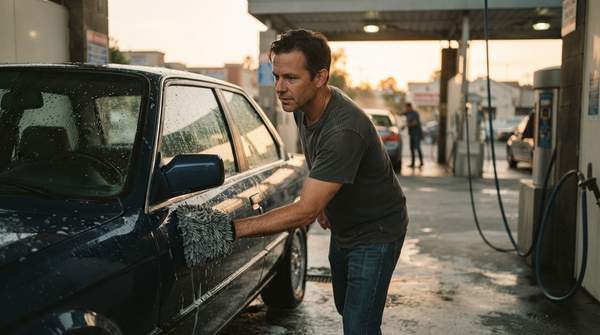
The single biggest factor separating the three most common local car washes is not price—it is what touches your paint, and how much control you have over it. Automatic tunnel washes are the fastest and cheapest per visit, but machine brushes can scratch paint and conveyor rails can scuff wheels. Self-service bays put you in charge and cost only for the minutes you use, provided you know which tools to keep off your paint. Full-service hand washes offer the most careful cleaning, but they cost the most, take the longest, and their results hinge entirely on the crew's technique. Here is how the three options actually work, what each does to your finish, and how to choose.
Automatic Car Washes: Speed and Convenience
An automatic wash pushes your car through a pre-programmed, mechanized tunnel that cleans it in a few minutes. Because the process is streamlined and standardized, operators can push a high volume of cars through quickly, which is why these washes dominate busy areas and peak hours. For a driver with a packed schedule who wants a clean car on the way home, nothing else on this list comes close on speed. Newgate School's comparison of commercial versus self car washing makes the point plainly: whichever automatic wash you choose, it saves you time and hassle.
The trade-off is what the machinery does to your finish. Yelp's cost guide, built from hundreds of thousands of real business quotes, summarizes the risk bluntly: machine washes are the cheapest option but can scratch a car's paint. Ben's ScratchFree CarWash, an operator's guide to wash types, adds a second hazard specific to tunnel systems: conveyor rails can scuff wheels. The same guide notes that many tunnels limit tall or lifted vehicles, duallys, and some accessories, so the format is not available to every vehicle at all. Not every machine wash damages paint—the risk varies with the specific equipment and how well it is maintained—but the friction-based machinery is the common cause of the scuffs and scratches owners report.
There is also a coverage limitation to weigh. Because the tunnel process is fixed and pre-programmed, it offers little customization or attention to particular features of your car. Hard-to-reach areas may simply not get the same cleaning a focused human could give them. For routine maintenance cleaning, that rarely matters. For a car with aftermarket accessories, an unusual body shape, or a finish you want to preserve as-is, it matters a lot.
Self-Service Bays: Control and Cost-Effectiveness
A self-service bay hands you the tools: a high-pressure wand, a foaming brush, and rinse settings, and you do the work yourself. Most bays are coin-operated, with each coin or token running the equipment for a set amount of time. Yelp's cost analysis calls self-service the cheapest option available short of washing at home, because you pay only for the time you use. Rice Street Car Wash in St. Paul, whose guide compares touchless and self-serve formats, highlights the same value proposition: bays let you choose concentrated soap, brush soap, wax, or spot-free rinse, so you decide exactly how your car gets cleaned.
That control comes with one significant paint hazard, and it is not the wand. The foaming brush is the problem. Ben's ScratchFree's operator guidance is direct: don't use the foaming brush on your paint, because other customers use it on muddy tires and truck beds, so it can hold grit. Use it on tires and wheel wells only. A shared brush that has just scrubbed someone's muddy wheel wells will carry that grit straight across your hood if you use it next. The risk is real but entirely avoidable with the right technique—the high-pressure wand and rinse settings are the safe tools for painted surfaces.
Where the self-service bay genuinely outperforms the other formats is messy, targeted work. Ben's guide names heavy mud, boat trailers, wheels, and undercarriages as the jobs self-serve bays handle best, and Rice Street's guide agrees, calling the format perfect for targeting wheels, wheel wells, and problem areas that automatic washes might miss. The time commitment is entirely up to you: a quick rinse-and-soap session is fast, while a thorough undercarriage job takes as long as you are willing to stand there and work. It handles everything from motorcycles to lifted trucks, and it rewards drivers who enjoy the hands-on approach.
Full-Service Hand Washes: Precision and Protection
A full-service hand wash is exactly what it sounds like: someone washes your vehicle by hand, often with interior cleaning included. Yelp's guide describes this tier as the gold standard, usually including a wash, wax, and full-body detailing, and it comes at the top of the price range. The averages Yelp reports for hand wash service run $30 to $60, with full-service wash and interior cleaning running $60 to $150 for regular-sized cars and $100 to $175 for SUVs and vans. It costs more and takes longer than the other two options.
What you buy with that money is care that machines cannot replicate. National Carwash Solutions, a car wash industry supplier, contrasts the two approaches directly: a hand wash relies on employees using buckets of soapy water, clean water, microfiber towels, and special cleaners to reach every nook and cranny, catering to specific areas that need extra attention. Where an automatic tunnel applies the same fixed process to every car, a hand wash can be adjusted to the vehicle in front of the crew. For owners who value that attention to detail, the industry analysis suggests the extra time can itself feel like part of the value.
The catch is that "hand wash" is not a guarantee of gentleness—it is a guarantee of human involvement. Ben's guide is blunt about the variable: a hand wash can be excellent when done carefully, but results depend on the crew's technique and how clean their mitts and towels are. A rushed crew reusing contaminated towels introduces the same grit-scratching risk as a dirty tunnel brush. Yelp's takeaway points the same direction: hand washes cost more but are gentler on a car's exterior, assuming the wash is done properly. You are paying for technique, and technique varies between providers.
Car Wash Comparison: Choose Your Best Option
The table below places the three wash types side by side across the four decision criteria that matter most—paint risk, cost, time, and ideal use—so you can match the option to your own priorities.
| Car Wash Type | Paint Safety Risk | Typical Cost | Time Commitment | Best For... |
|---|---|---|---|---|
| Automatic Tunnel Wash | Machine brushes can scratch paint; conveyor rails can scuff wheels. Risk varies with the wash's equipment and maintenance. | Cheapest commercial option per Yelp's quote analysis; prices vary by location and package. | Fastest—mechanized process cleans a car in a few minutes. | Speed and convenience on a busy schedule; regular maintenance cleaning, including winter salt removal. |
| Self-Service Bay | Moderate—avoidable if you keep the shared foaming brush off your paint, since it holds grit from other customers' tires and truck beds. | Cheapest short of home washing; coin-operated, you pay only for the time you use. | Entirely up to you—depends on your effort and thoroughness. | Full control; heavy mud, wheels, wheel wells, undercarriages, and problem areas automatic washes miss. Handles everything from motorcycles to lifted trucks. |
| Full-Service Hand Wash | Lowest when done carefully, but results depend on the crew's technique and how clean their mitts and towels are. | Highest—Yelp reports hand wash averages of $30–60, and $60–150 for full-service wash plus interior cleaning on regular cars. | Longest—a detail-oriented process done by hand. | Vehicles whose paint you want preserved, and owners who value meticulous, customized cleaning with interior service. |
Read down the paint-risk column and the pattern is clear: risk comes from grit and friction, whether that is tunnel machinery, a contaminated shared brush, or dirty crew towels. Cost and time run in the opposite direction from control—the more human attention involved, the more you pay and the longer you wait. Cost figures are general ranges that vary by location and service package, not pricing for any specific wash.
Making Your Car Wash Decision
Choose the car wash type that best balances your priorities for paint protection, budget, and time commitment, understanding that each method carries distinct trade-offs. If finish preservation on a newer or cherished vehicle is the priority, a carefully done hand wash is the defensible spend, provided you trust the crew's technique and clean tools. If budget and control lead, use a self-service bay, keep the foaming brush to tires and wheel wells only, and take the time to hit the areas tunnels miss. If speed is what your week allows, the automatic tunnel is a reasonable choice—just accept the paint risk, check whether your vehicle and accessories fit the tunnel, and remember that pre-programmed cleaning leaves gaps.
Whichever you pick, the outcome is checkable. The measurable indicator is this: the car's paint finish remains free of new swirl marks or scratches, and the cleaning results consistently meet expectations for the chosen method and cost. Inspect your paint in direct light after a few washes. If new scuffs appear from a tunnel, or grit marks from a bay visit, switch methods—say, rotating between formats as Newgate School's comparison suggests—rather than paying repeatedly for a result that is damaging the very thing you are trying to keep clean.
Sources
- Commercial Car Wash Vs. Self Car Wash: Which Should You Choose? - Newgate School — Newgateschool
- Cost of Car Wash - Last Updated November 2026 - Yelp
- Types of Car Washes: Touchless vs. Brushless vs. Self-Serve — Ben's ScratchFree CarWash
- Touchless vs. Self-Serve Car Wash: Which is Right for You? — Rice Street Car Wash St Paul MN
- Automatic Car Wash vs. Hand Wash: Key Differences — NCS National Carwash Solutions