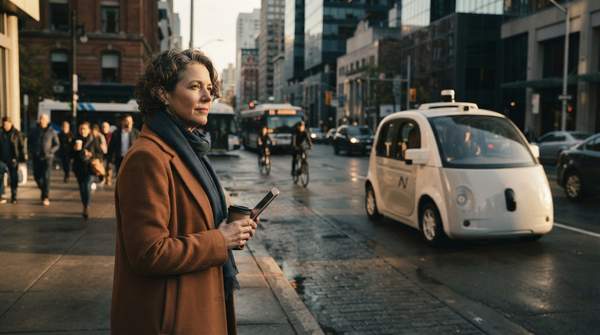
Driverless ride-hailing is arriving in American cities not as a single federal decision but as hundreds of local ones. While states register and permit autonomous vehicles and Washington sets vehicle standards, city and county governments retain real leverage over how robotaxis use their streets, their curbs and their budgets. That leverage matters because the research on conventional ride-hailing points to a genuine tension: services that feel like pure convenience to an individual rider can, in aggregate, pull riders off public transit and add vehicles to already crowded roads. Understanding which levers your local officials actually hold is the first step to weighing that trade-off honestly.
Your City's Power Over Driverless Ride-Hailing: A Decision Framework
The framework below organizes the powers that local governments can exercise over driverless ride-hailing, drawn from a Urban Institute analysis of how autonomous vehicle regulation is divided among federal, state and local authorities in the United States, and pairs each with the community outcome it can influence. Not every city holds every lever in the same way: the Urban Institute authors note, for example, that states sometimes preempt local rules on autonomous vehicle road use. The framework applies to the U.S. governance structure and does not constitute legal advice for any particular municipality.
| Policy area | What your city can do | Community stakes |
|---|---|---|
| Ride-hailing service rules | Some cities impose rules on service requirements, costs and safety for passengers | Shapes affordability, reliability and rider protection |
| Fees, taxes and subsidies | California has taxed AV ride-sharing trips; some cities add fees on ride-hailing services, and some provide ride-hailing subsidies for certain users | Raises revenue for local goals or lowers fares for groups the city prioritizes |
| Vehicle accessibility | Some cities require a minimum share of the ride-hailed fleet to be ADA accessible; California requires providers to share data on accessible-vehicle requests and successful trips | Determines whether disabled residents share in the service's benefits |
| Street design and signage | Cities may add specific signage and markings on streets under their jurisdiction | Influences how safely autonomous vehicles interact with local street conditions |
| Pedestrian and cyclist protections | Some cities have developed Vision Zero plans to reduce pedestrian and cyclist fatalities through street design | Governs whether more vehicle traffic comes with protective design or without it |
| Curb access and geofencing | Cities may set rules on road access for streets they control, enforce nonmoving violations such as double parking, and designate lanes and curb space for specific uses | Manages pickup and drop-off zones, congestion at busy curbs and loading behavior |
Read down the first column and a pattern emerges: nearly every contested question about robotaxis — where they stop, who they serve, what they cost the public — maps to a power a city council or transportation department already exercises over streets and curb space. The framework's purpose is not to tell a city what to do, but to show residents that these decisions are local, contestable and consequential.
Local Government's Role: Key Regulatory Levers
The Urban Institute's review of scholarship and interviews breaks autonomous vehicle authority into three layers. The federal role is narrow in the areas that matter most for ride-hailing: the Federal Highway Administration publishes the Manual on Uniform Traffic Control Devices, but with no specific rules for autonomous vehicles, and it has no role in ride-hailing requirements, accessibility, subsidies, curb use or crash response. States, through their DMVs, typically handle registration and are developing autonomous vehicle permitting programs, with some states imposing their own requirements for crosswalks and pedestrian protection.
Cities occupy the practical middle. They can sometimes impose rules related to service requirements, costs and passenger safety. They can set curb and lane designations, enforce nonmoving violations such as double parking, and decide which streets under their jurisdiction carry which signage. Some municipalities have gone further: California, for instance, has taxed autonomous vehicle ride-sharing trips, and some jurisdictions require that a minimum share of the ride-hailed fleet meet Americans with Disabilities Act standards.
Critically, the report also identifies where local power stops. States can preempt local regulation of autonomous vehicle road use, and registration and permitting generally sit with state DMVs. That means residents who want to influence robotaxi policy may need to work at two levels — pressing city hall on curbs, fees and street design while tracking state legislatures on access and permitting. A city that understands which lever it actually holds can avoid spending political capital on decisions that were never its own.
The Trade-Offs: Convenience vs. Community Goals
The core tension is easy to state and hard to resolve: what is efficient for one rider can be inefficient for a whole city. Research from UC Davis's STEPS program on how ride-hailing affects travel behavior found that while ride-hailing can be complementary to public transit — and ride-hailing firms themselves make that argument — the net effect across the entire population is an overall reduction in public transit use and a shift toward lower-occupancy vehicles, meaning more cars.
Carnegie Mellon University researchers studying Uber and Lyft's effects on U.S. cities quantified a similar imbalance. Substituting a ride-hail trip for a personal vehicle can reduce air pollution costs by 9 to 13 cents, but the extra driving to and from passengers increases congestion, crash risk and climate costs by about 45 cents. In car-dependent and slow-growth cities, car ownership actually rose as transportation network companies entered, and transit ridership was displaced most in cities with higher incomes and fewer children — evidence that impacts vary sharply by the kind of city involved.
Driverless operation could amplify either side of that ledger. Writing in The Urban Condition, journalist Benjamin Schneider argues that because cars — including autonomous and electric ones — are inefficient at moving many people at once, a robotaxi-dominated system would have a relatively low ceiling on capacity, keeping automotive traffic a paramount concern. He notes that "opponents of transit referenda in Austin and Nashville have pointed to robotaxis as a justification not to invest in new light rail systems."
The flip side is that the same technology could be deliberately woven into transit rather than set against it. The Urban Robotics Foundation, an industry-aligned organization writing about robotaxi adoption, describes the alternative: incorporating subsidized, multi-passenger robotaxis as new forms of public transportation, while anticipating that robotaxi growth will follow a classic S-curve over a generation or more, with the deepest disruption in the middle years. The direction a city lands in is not predetermined; it depends on whether pickups happen at transit stops or instead of them, and whether shared, subsidized service is what local fees and curb policy reward.
Impact on Workers and Public Perception
The labor question is the least regulated of the bunch and, for many residents, the most personal. Professional driving is a significant source of flexible income in most metro areas, and autonomous ride-hailing is widely expected to displace human ride-share and delivery drivers. Lyft, one of the companies building toward a hybrid human-and-autonomous network, has acknowledged the human value at stake, describing drivers who help passengers with luggage, assist those who need a hand, and "most importantly, provide genuine human connection."
Lyft says the journey toward a hybrid network will be complex, with many phases, challenges and opportunities ahead, and that it is committed to managing the evolution in a way that continues to support drivers. That is a corporate commitment, not a binding guarantee, and the company frames it in service terms — spotlighting the differentiated value of in-person hospitality — rather than as a specific transition plan. Residents and officials evaluating these claims should treat them as one participant's stated strategy in a transition whose pace and distribution of harm remain open questions.
Public perception will shape the regulatory environment as much as the technology does. If robotaxis become associated with safer streets, early adopters who already rely on taxis and ride-hail may normalize them quickly, as the Urban Robotics Foundation anticipates. If they become associated with curb chaos, blocked bus stops and job losses, the same local powers described above — fees, curb designations, access rules — are the tools a skeptical public can ask its city to use. Either way, the outcome is a policy choice, not a technological inevitability.
Navigating the Future: Your Role in Local AV Policy
The practical decision for local residents and businesses is to engage with their city's planning and transportation departments to advocate for policies that balance individual convenience with broader community goals, leveraging the identified regulatory levers. That means knowing which questions belong to your city — service rules, accessibility minimums, fees and subsidies, curb allocation, street design — and which belong to your state legislature or federal regulators.
How cities regulate these services, and how consumers adopt them, will determine whether the benefits materialize and whether the risks of congestion and job displacement are managed. Neither outcome is guaranteed by the technology itself.
There is a concrete way to watch this unfold in your own municipality: monitor local government meeting agendas for discussions or proposals related to autonomous vehicle regulations, curb management, or public transit integration strategies. When a robotaxi item first appears on a council or planning commission agenda, the window in which your city's levers can still be shaped is open — and the curb, the fee and the accessible-fleet minimum are all on the table.
Sources
- URBAN
- New research on how ride-hailing impact travel behavior By Regina R. Clewlow, Ph.D. – STEPS
- The Effects of Uber and Lyft in U.S. Cities — News
- How robotaxis could transform cities — Benjaminschneider
- How much will robotaxis really reshape cities? — Urban Robotics Fdn.
- Shaping the Future of Rideshare, Together Introducing the Lyft Driver Autonomous Forum